The bigger story, however, goes beyond the first billion visits. Roblox itself reported that Grow a Garden reached 21.6 million concurrent players, setting a Guinness World Records achievement for the most concurrently played video game at the time. Robloxian Verse Today, third-party tracking pages report that the experience has grown far beyond its original billion-visit milestone, with one October 2026 tracker listing roughly 36 billion total visits and more than 11 million favourites.
Grow a Garden 1 Billion Visits: Key Facts
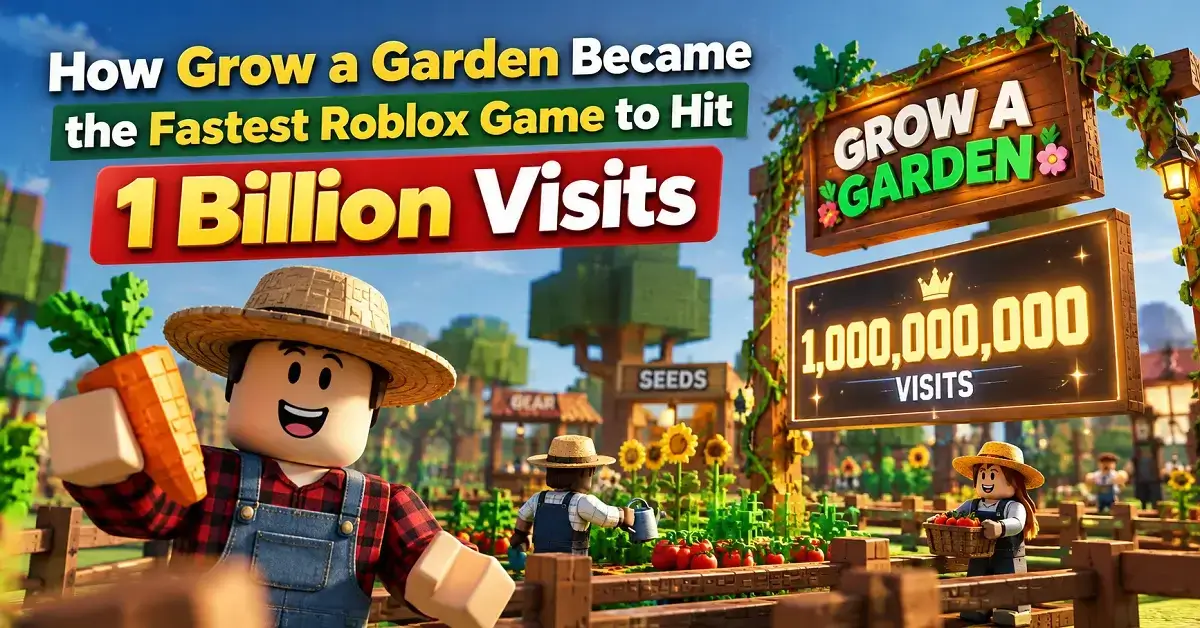
Before looking at why Grow a Garden became so successful, it helps to put the milestone into context. The game launched in March 2025 and reached 1 billion visits only 33 days later, making it the fastest Roblox experience to reach that milestone at the time.
Grow a Garden Milestone at a Glance
| Fact | Details |
|---|---|
| Game | Grow a Garden |
| Platform | Roblox |
| Release | March 2025 |
| 1 Billion Visits | Reached in 33 days |
| Peak Concurrent Players | More than 22 million |
| September 2026 Visits | About 35.9 billion |
| Favorites | More than 11 million |
The numbers show why the one-billion milestone matters. It was not simply a popular Roblox game accumulating visits over several years. Grow a Garden reached the milestone during the first month of its release and then continued growing into one of Roblox’s most-played experiences.
Roblox’s own experience page currently lists more than 35.9 billion visits and more than 11.4 million favorites, showing that the original 1 billion milestone was only the beginning of the game’s growth.
What Is Grow a Garden?
Grow a Garden is a Roblox farming and simulation experience built around an idle progression system. You start with a small plot, purchase seeds, plant crops, wait for them to grow, harvest the results, and sell what you produce for in-game currency. The defining twist is that your garden continues developing even when you are offline, giving the game an unusually low-pressure rhythm compared with many Roblox experiences.
That design matters because it removes one of the biggest barriers to casual gaming: the feeling that you have to stay online to make progress. You can plant something before leaving, return later, harvest it, and use your earnings to buy something better. As your garden expands, you encounter rarer crops, mutations, pets, equipment, decorations, events, and limited opportunities. The result is a progression system that feels more like tending a living collection than completing a traditional mission list.
The official Roblox experience page describes the basic loop in remarkably direct terms: buy seeds when the shop restocks, plant them, wait for growth, harvest them, and collect profits. It also explicitly emphasizes that the garden grows while you are offline. That simplicity is part of the game’s expertise rather than a weakness; the player understands the objective almost immediately, while the deeper collection and optimization systems give experienced players plenty to investigate.
The Game That Hooked Millions of Players
The scale of the audience became extraordinary very quickly. Grow a Garden was initially made by a teenage Roblox developer known online as BMWLux, reportedly in only a few days, before Janzen “Jandel” Madsen and Splitting Point Studios became involved and expanded the project with additional development support. GamesBeat reported that the team encountered the game when it was still around hundreds of concurrent users and began turning it into a live-service experience with regular updates.
That transition is important when evaluating the game’s success. The original concept may have been simple, but the operation around it became much more sophisticated. Weekly content, events, new items, balance changes, social moments, and community engagement transformed a small farming simulator into an experience capable of producing enormous traffic spikes. Roblox itself has cited Grow a Garden as an example of an experience that went from comparatively unknown to requiring infrastructure capable of handling unprecedented traffic.
Reaching 1 Billion Visits in Just 33 Days: How Did It Happen?

The headline achievement is remarkably straightforward: Grow a Garden reached 1 billion visits in 33 days. Roblox community tracking and later reporting consistently identify it as the fastest experience to reach that milestone, which it achieved in May 2025. Statista’s September 2026 ranking still identifies Grow a Garden as the fastest Roblox experience to reach one billion visits, while current tracking shows that its lifetime total has since grown into the tens of billions.
The speed becomes easier to understand when you examine what happened immediately afterward. The robloxian game repeatedly broke its own concurrent-player records as major updates arrived. It passed approximately five million concurrent users during the Blood Moon period, climbed to roughly 8.9 million later in May, exceeded 11 million around the Bizzy Bees update, and eventually reached more than 22 million concurrent users during its peak period. Roblox itself reported a 21.6 million concurrent-player record in June 2025, while third-party trackers put the later all-time peak at 22,375,597 on August 23, 2025.
| Grow a Garden milestone | Reported figure |
|---|---|
| Release | March 2025 |
| Time to 1 billion visits | 33 days |
| Major early CCU milestone | About 5 million |
| May 2025 peak | About 8.9 million |
| Later record peaks | More than 20 million |
| All-time tracked peak | 22,375,597 CCU |
| Visits by September 2026 | About 35.9 billion |
The lesson is bigger than the one-billion number. A Roblox game does not reach that scale merely because it has a good idea. It needs a loop that players understand instantly, systems that encourage repeat visits, content capable of creating new reasons to return, and enough social momentum to move outside the platform itself. Grow a Garden managed to combine all four.
How Fast Did Grow a Garden Reach 1 Billion Visits?
Reaching 1 billion visits in 33 days becomes even more impressive when you convert the milestone into an average daily pace.
Mathematically, 1 billion visits divided across 33 days works out to approximately:
- 30.3 million visits per day
- 1.26 million visits per hour
- 21,000 visits per minute
- About 351 visits per second
These figures are mathematical averages, not a claim that the game received the same number of visits every second. Roblox traffic changes significantly during updates, events, weekends, creator promotions, and viral moments.
The calculation nevertheless gives useful perspective. Grow a Garden did not need years to accumulate its first billion visits. It generated an extraordinary volume of experience sessions almost immediately after launch, helping establish the game as one of the fastest-growing Roblox experiences ever recorded. Its growth also accelerated as major updates produced increasingly large concurrent-player spikes. The game moved from hundreds of concurrent users in its early development to around 100,000 concurrent users within roughly two weeks, according to Janzen “Jandel” Madsen’s account to GamesBeat.
Why Is Grow a Garden So Popular? Breaking Down the Success
The best way to understand Grow a Garden’s popularity is to stop thinking of it as merely a farming game. Its real strength is the way several retention mechanisms overlap. You have progression because better seeds create better results, anticipation because shops and events rotate, collection because rare crops and pets become desirable, social comparison because players can show off gardens, and relaxation because there is no constant requirement to fight or win.
This combination gives the game unusually broad appeal. A player who only has a few minutes can check crops and collect profits. Someone with more time can optimize mutations, collect pets, decorate a garden, participate in events, or chase rarer items. That flexibility is one reason the game can appeal simultaneously to casual players and highly engaged Roblox users.
Roblox’s own reporting also gives an important platform-level explanation: its discovery systems, including personalized discovery and curated surfaces, helped new experiences reach audiences quickly. In Roblox’s Q2 2025 shareholder letter, the company specifically identified Grow a Garden as a title that benefited from AI-driven discovery and curated recommendations before becoming its top experience by spending within a month of launch.
Addictive Open Play Mechanics
The core loop is almost aggressively simple: plant, wait, harvest, sell, upgrade, repeat. Yet simplicity does not mean shallow design. The offline-growth mechanic creates a psychological bridge between sessions because the garden is never completely static. When you leave the game, you are not necessarily abandoning your progress; you are effectively starting a timer that can produce something useful when you return.
That is a smart retention structure because it works with the player’s schedule rather than against it. Traditional games often reward you for spending another hour online. Grow a Garden can reward you for remembering to come back later. The distinction sounds small, but from a live-service design perspective it changes the entire relationship between player and game.
There is also an element of uncertainty. Seeds can rotate through shops, crop outcomes can vary, mutations can increase value, and limited events can create temporary opportunities. This means your next session may not be identical to your previous one. You are not simply repeating a fixed checklist; you are checking what the game has available today and deciding what is worth pursuing.
Rotating Seeds, Tools, and Exclusive Cosmetics
Scarcity is another major ingredient. When valuable seeds, tools, pets, decorations, or event rewards are not permanently available in exactly the same way, players have an incentive to check back. A shop rotation effectively becomes a reason to visit the game even when you do not have a specific farming objective.
For new players, the smartest approach is not to chase every attractive item immediately. You should first establish a reliable economic base. Grow inexpensive crops, reinvest your profits, learn which crops and mutations generate strong returns, and gradually build toward higher-value resources. Spending every available resource simply because something looks rare can slow your progression.
Limited cosmetics work differently from crops. Their value is often social rather than economic. A rare decoration can communicate that you were present during a particular event or reached a particular milestone. In a social platform such as Roblox, that kind of visible status can be surprisingly powerful because the garden itself becomes part of your identity.
The Impact of Rolling Themes and Updates
Live updates gave Grow a Garden another advantage: they repeatedly reset the conversation around the game. A new event can turn a mature game back into something worth discussing because creators suddenly have new content to explain, players have new goals to chase, and communities have new questions to answer.
This was visible throughout the game’s explosive growth. Major updates corresponded with significant jumps in concurrent users, including the Blood Moon, Bizzy Bees, Summer Update, and later events. The pattern demonstrates an important live-service principle: content does not have to replace the core game to refresh player interest. Sometimes you only need to add a new layer to an already effective loop.
The Roblox experience remains active in October 2026, with the official page showing continuing events and updates. That ongoing support is important because a game with tens of billions of visits still needs reasons for its existing audience to return rather than relying only on new players.
Viral Marketing: The Role of TikTok and Roblox YouTubers
Grow a Garden also benefited from a perfect environment for viral discovery. The game’s visual results are easy to demonstrate: enormous crops, unusual mutations, rare pets, valuable harvests, unexpected events, and impressive gardens all make straightforward short-form content.
A creator does not need to spend ten minutes explaining the entire game before producing an interesting clip. A giant crop or unusual mutation can communicate the idea almost instantly. That makes the experience naturally suited to TikTok, YouTube Shorts, Roblox YouTube channels, and community posts.
The game’s rapid growth was not simply a case of influencers manufacturing popularity from nothing. The underlying game already gave creators plenty of repeatable material. That distinction matters. Viral marketing can attract an audience once, but only a strong gameplay loop can convert curiosity into repeated visits. Grow a Garden had both sides of the equation.
The Business Side: How Much Money Does Grow a Garden Make a Day?
This is where you need to separate verified information from estimates. The developers have not publicly disclosed a reliable official figure for Grow a Garden’s daily profit, so claims such as “the game makes exactly X dollars every day” should not be presented as established fact.
Third-party services publish estimates based on visits, player activity, monetization assumptions, and other signals. One current tracker estimates annual revenue in the range of roughly $6 million to $14.4 million, equivalent to approximately $500,000 to $1.2 million per month, but these are model-based estimates rather than financial statements from the developers. Another third-party earnings ranking estimates the game generated more than $150 million during 2025. These figures should therefore be treated as estimates, not audited revenue.
The commercial model itself is easier to understand. Grow a Garden uses Roblox’s Robux ecosystem, with purchases connected to seeds, cosmetics, upgrades, convenience features, and other virtual goods. The game became one of Roblox’s leading experiences by spending, and Roblox reported that viral experiences such as Grow a Garden contributed to stronger platform engagement and spending during 2025. Roblox’s Q2 results showed 111.8 million daily active users, up 41% year over year, while bookings also benefited from the surge around viral experiences.
So, if you are writing about its business performance, the safest expert phrasing is: Grow a Garden is clearly a major commercial success, but its exact daily revenue is private and third-party dollar estimates are not official financial results.
Who Is the New Owner of Grow a Garden?
The ownership story is more complicated than simply naming one “new owner.” The game began with its original creator, known online as BMWLux, and later attracted Janzen “Jandel” Madsen and Splitting Point Studios. Do Big Studios also became involved and holds a minority interest according to reporting about the game’s development structure.
Jandel’s involvement was particularly important because Splitting Point brought experience in running Roblox live-service games and regular update cycles. GamesBeat reported that the team partnered with the original creator when the game was still very small and introduced the live-service approach that helped accelerate its growth.
There is also an important distinction between Roblox’s listed creator/group ownership and private commercial ownership arrangements. The Roblox experience is currently listed under The Garden Game, while public reporting describes the underlying project as involving the original creator, Splitting Point Studios, and Do Big Studios. Exact ownership percentages beyond statements attributed to the parties have not been fully disclosed publicly.
That means you should be cautious with articles claiming that one company simply “bought Grow a Garden outright.” The available evidence supports a shared and evolving ownership/development structure rather than a straightforward public sale to one new owner.
Grow a Garden Codes & Expert Tips for New Players
If you are starting Grow a Garden today, do not build your entire strategy around codes. Codes can be useful when active, but their availability changes and third-party lists frequently disagree. For example, October 2026 code trackers report RDCAward and BEANORLEAVE10 as active, while other websites publish different lists, showing why players should verify a code before treating it as guaranteed.
The safest approach is to use codes as a bonus rather than your primary progression system. Current reports indicate that the more consistently reported codes reward cosmetics rather than dramatically changing your farming economy
Useful beginner habits include:
- Check the seed shop regularly rather than spending everything immediately.
- Prioritise progression over collecting every cosmetic early in the game.
- Pay attention to mutations, because rarity can significantly change crop value.
- Use events strategically, especially when limited-time content is available.
- Compare your garden setup with experienced players to understand efficient progression.
- Treat codes as temporary bonuses, because codes can expire without much warning.
- Avoid unofficial “code generators” or websites asking for your Roblox credentials.
When redeeming a legitimate code, current guides generally direct players to launch Grow a Garden, open the Settings menu, enter the code in the redemption field, and claim the reward.
The Future of the Franchise: Best Grow a Garden 2 Guides and Upcoming Sequels
The future of the franchise is no longer purely hypothetical. Grow a Garden 2 has already emerged as a separate experience, so players looking for “Grow a Garden 2 guides” should treat it as a distinct game rather than simply an announced sequel that has not arrived.
Current third-party tracking shows Grow a Garden 2 operating at a much smaller scale than the original, with several thousand concurrent players and hundreds of thousands of new visits on some October 2026 days. That does not automatically make it unsuccessful; sequels often face a difficult problem because the original game already owns the audience’s attention.
For players moving between the two experiences, the most useful guide strategy is to avoid assuming that every mechanic, code, crop value, or progression method from the original transfers directly. Treat each game’s economy independently. Check its current shops, events, codes, progression systems, and community updates before investing significant time or Robux.
As for future sequels beyond Grow a Garden 2, there is no need to manufacture rumors. Unless the developers make an official announcement, claims about Grow a Garden 3 or another numbered sequel should be considered speculation. The more interesting question is whether the franchise can reproduce the original’s formula: a simple core loop, frequent reasons to return, strong social visibility, and enough novelty to keep the community talking.
Does 1 Billion Visits Mean 1 Billion Players?
No. One of the most important details to understand about the Grow a Garden 1 billion visits milestone is that visits are not the same as unique players.
A visit generally represents an experience session or entry into the Roblox experience. The same person can generate multiple visits by leaving and returning to the game. Concurrent players are different again: that number represents how many users are playing at the same time.
For example, Grow a Garden’s historic peak of more than 22 million concurrent players does not mean that 22 million people played only once. It means that more than 22 million users were connected to the experience at approximately the same time.
This distinction makes the 1 billion figure easier to interpret. It represents an enormous volume of game sessions rather than 1 billion individual people. Understanding the difference between visits, concurrent players, daily active users, and current players is essential when comparing Roblox games. Using the wrong metric can make a game’s audience appear much larger or smaller than it actually is.
Grow a Garden Player Numbers and Milestones
One of the easiest mistakes when discussing Grow a Garden is confusing visits, concurrent players, daily active users, and current players. These numbers measure completely different things. A visit is a session or experience entry, concurrent users are players online at the same time, daily active users count unique users within a day, and a current-player counter is simply a snapshot.
At its peak, Grow a Garden demonstrated an extraordinary concurrent audience. Roblox officially reported 21.6 million simultaneous players in June 2025, while third-party tracking later recorded an all-time peak of 22,375,597 concurrent users in August 2025. That record was later surpassed by another Roblox experience, so it is more accurate to describe Grow a Garden as a former concurrent-player record holder, not the permanent holder of the record.
By late September 2026, the game had passed approximately 35.9 billion visits, according to GEEIQ’s analysis of the Roblox experience page. That is an enormous lifetime audience even though current player counts are far below the 2025 peak.
| Metric | What it tells you |
|---|---|
| 1 billion visits | How quickly the game accumulated experience sessions |
| 22.3M peak CCU | Its largest recorded simultaneous audience |
| 35.9B+ visits | Its enormous lifetime reach by September 2026 |
| Current CCU | The number playing at a particular moment |
| Favorites | A rough signal of how many users saved the experience |
The difference is crucial for SEO content as well. Saying “22 million players play Grow a Garden every day” would be misleading because the 22-million figure represents a concurrent peak, not a normal daily player count. Current tracking shows a much smaller live audience than the historic peak, which is completely normal for a mature viral Roblox experience.
Final Thoughts
Grow a Garden’s rise to 1 billion visits shows how a simple Roblox concept can develop into a global gaming success through strong retention, accessibility, and consistent live-service updates. Reaching the milestone in just 33 days highlighted the scale of Roblox’s discovery ecosystem, while the game’s continued growth showed that its appeal extended beyond short-term viral attention. Its core loop—planting crops, waiting for growth, harvesting, selling, and reinvesting—remains easy for new players to understand while offering enough progression to encourage repeat sessions.
From a game-design perspective, Grow a Garden demonstrates that complexity is not always necessary for long-term engagement. Features such as offline progression, crop mutations, pets, rotating shops, events, cosmetics, and community-driven content add depth without overwhelming the basic farming experience. For players starting today, the best approach is to understand the crop economy, learn how mutations and events work, use legitimate codes, and develop the garden gradually. For Roblox creators, the bigger lesson is clear: viral exposure can bring players in, but a rewarding gameplay loop, regular updates, and meaningful reasons to return are what turn attention into lasting success.